

|
Getting your Trinity Audio player ready...
|
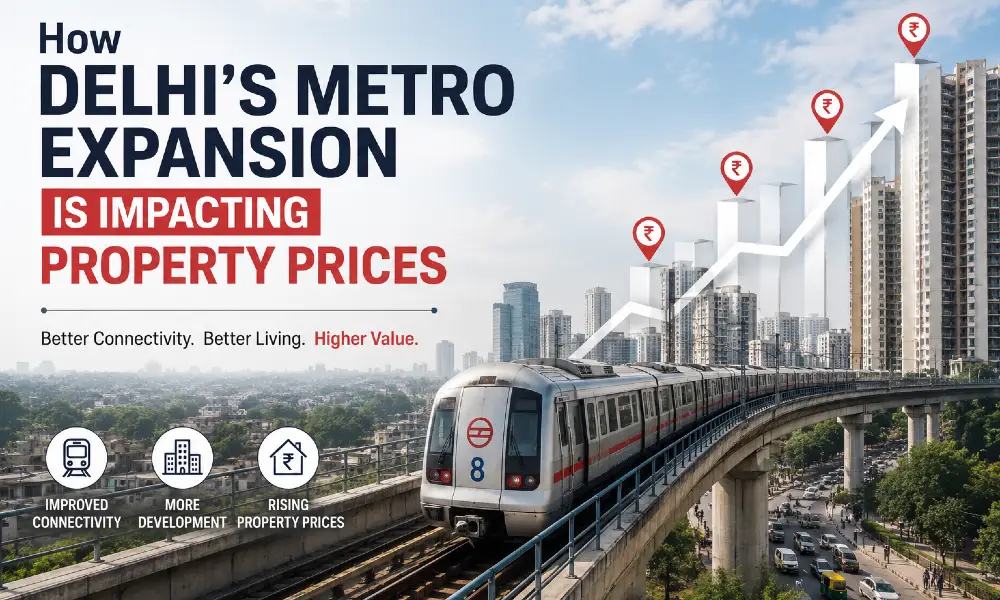
Delhi’s Metro network has become more than just a convenient way to travel. As new corridors, extensions, and stations improve connectivity across Delhi and the wider NCR, they are also influencing where people want to live, work, and invest.
For property buyers and investors, metro connectivity is increasingly becoming an important factor when evaluating residential and commercial real estate. Areas that once had limited accessibility can become more attractive after gaining direct or improved access to the Metro network.
How Does Metro Expansion Influence Property Prices?
The relationship between Metro connectivity and property prices is relatively straightforward: better accessibility can increase an area’s attractiveness.
When a new Metro station opens nearby, residents may benefit from:
- Shorter and more predictable commuting times
- Better access to employment hubs
- Easier connectivity to markets, schools, hospitals, and entertainment
- Reduced dependence on private vehicles
- Greater rental demand
- Improved commercial activity around stations
As demand increases, property values and rental rates can also experience upward pressure.
1. Properties Near Metro Stations Often Become More Attractive
Properties located within convenient walking or short commuting distance of Metro stations generally receive greater attention from buyers and tenants.
For example, someone working in Connaught Place, Gurgaon, Noida, or another major employment hub may prefer a home close to a Metro station because it can make daily commuting easier.
This creates an important advantage for properties located around well-connected Metro corridors.
However, proximity alone does not guarantee a significant price increase. Factors such as neighbourhood quality, road connectivity, parking, construction quality, amenities, and overall demand also play an important role.
2. Rental Demand Can Increase
Metro expansion can have a particularly noticeable impact on rental markets.
Students, working professionals, and families often prefer locations with reliable public transport. A property near a Metro station can therefore become easier to rent, especially when the station provides convenient connections to major employment and education hubs.
Higher tenant demand can potentially result in:
- Faster property occupancy
- Better rental yields
- Increased monthly rents
- Greater interest from investors
This is one reason why investors often monitor upcoming Metro corridors before making real estate decisions.
3. Commercial Property Can Benefit Too
The impact of Metro expansion is not limited to residential properties
Retail shops, offices, restaurants, clinics, and other businesses can benefit from increased pedestrian movement and improved accessibility.
Areas surrounding busy Metro stations may attract:
- Retail stores
- Food outlets
- Small offices
- Service businesses
- Co-working spaces
- Healthcare facilities
As commercial activity develops, surrounding properties can become more valuable.
4. Upcoming Metro Corridors Can Create Investment Interest
One of the most interesting aspects of Metro-led development is that property markets may react before a new station becomes operational.
Once a proposed corridor receives significant attention and construction progresses, buyers and investors may begin looking at nearby areas.
This can create opportunities in locations where property prices are still comparatively affordable.
However, investors should distinguish between:
Announced Project → Under Construction → Near Completion → Operational
The actual impact on property prices can vary significantly at each stage.
5. Peripheral Areas May Become More Connected
Metro expansion can also help integrate peripheral neighbourhoods with established parts of Delhi and NCR.
Improved connectivity can make previously less-preferred locations more practical for residents who commute regularly.
This may encourage development of:
- New residential projects
- Affordable housing
- Rental properties
- Retail centres
- Offices and commercial developments
Over time, better connectivity can contribute to broader urban development around Metro corridors.
Delhi Areas That Could See Greater Connectivity Benefits
Different parts of Delhi and NCR can experience different effects depending on the Metro corridor, station location, existing infrastructure, and local property demand.
Neighbourhoods with improved Metro connectivity can become more attractive when they also offer good roads, established markets, schools, healthcare facilities, and employment access.
Some areas may experience a stronger effect because they connect directly with major business and commercial destinations, while others may benefit mainly through improved local accessibility.
Metro Connectivity vs. Property Price: What Buyers Should Understand
It is tempting to assume that property prices automatically rise whenever a Metro station is introduced. In reality, the relationship is more complicated.
Consider these factors before purchasing a property:
| Factor | Potential Impact |
|---|---|
| Distance from Metro Station | Convenient access can improve buyer and tenant interest |
| Metro Line Connectivity | Direct routes can be more valuable than multiple transfers |
| Road Infrastructure | Good roads improve overall accessibility |
| Employment Hubs Nearby | Stronger commuting demand can support rentals |
| Social Infrastructure | Schools, hospitals and markets increase liveability |
| Property Quality | Newer and better-maintained properties may attract more demand |
| Noise & Traffic | Properties immediately beside busy stations may face disadvantages |
| Future Development | New commercial and residential projects can influence demand |
Does Buying Near a Metro Station Always Make Sense?
Not necessarily.
A property located extremely close to a busy Metro station may have advantages in accessibility but could also experience higher traffic, noise, congestion, or limited parking.
For homeowners, the ideal distance may depend on personal preferences. For investors, the focus should also be on rental demand, resale potential, infrastructure development, and the overall economics of the property.
Rather than buying simply because a Metro station is nearby, buyers should evaluate the complete neighbourhood.
What This Means for Property Investors
Delhi’s continuing Metro expansion can create new opportunities for real estate investors, but timing and location are important.
Investors should look beyond the Metro map and research:
- The exact station location
- Expected completion timelines
- Existing property prices
- Historical price movement
- Rental demand
- Upcoming residential and commercial projects
- Road and last-mile connectivity
- Nearby employment centres
- Social infrastructure
- Future development plans
A Metro station can be a strong supporting factor, but it should not be the only reason for purchasing a property
The Importance of Last-Mile Connectivity
Metro connectivity works best when residents can easily travel between their homes and stations.
Therefore, areas with good availability of e-rickshaws, buses, autos, pedestrian routes, and roads may benefit more than locations where the station is technically nearby but difficult to reach.
For property buyers, door-to-station accessibility can sometimes be just as important as the Metro line itself.
Long-Term Impact on Delhi Real Estate
Delhi’s Metro expansion is likely to continue influencing the city’s real estate landscape by improving accessibility and supporting urban development.
The strongest opportunities may emerge where Metro connectivity combines with other growth factors, including new commercial centres, residential development, improved roads, employment opportunities, and better civic infrastructure.
For homeowners, better Metro connectivity can improve everyday convenience. For landlords, it can support tenant demand. For investors, it can become one of several indicators of an area’s future potential.
Conclusion
Delhi’s Metro expansion is reshaping not only the city’s transportation network—it is also influencing real estate preferences across residential and commercial markets.
Better Metro connectivity can increase accessibility, support rental demand, encourage commercial development, and make emerging neighbourhoods more attractive. However, property prices depend on many factors, and proximity to Metro alone does not guarantee appreciation.
For anyone considering a property purchase in Delhi, the Metro should be viewed as an important part of a broader investment analysis rather than the sole deciding factor.
In short, the Metro can bring people closer to opportunities—and that improved connectivity can also bring greater attention to the properties around it.
Don’t Miss: Inside Delhi Gate Book Market: Books, Bargains & Hidden Treasures
